
Pet food guide: three areas to review
When comparing suppliers, look beyond product photos and individual ingredients. Focus on these three areas as you build your shortlist.
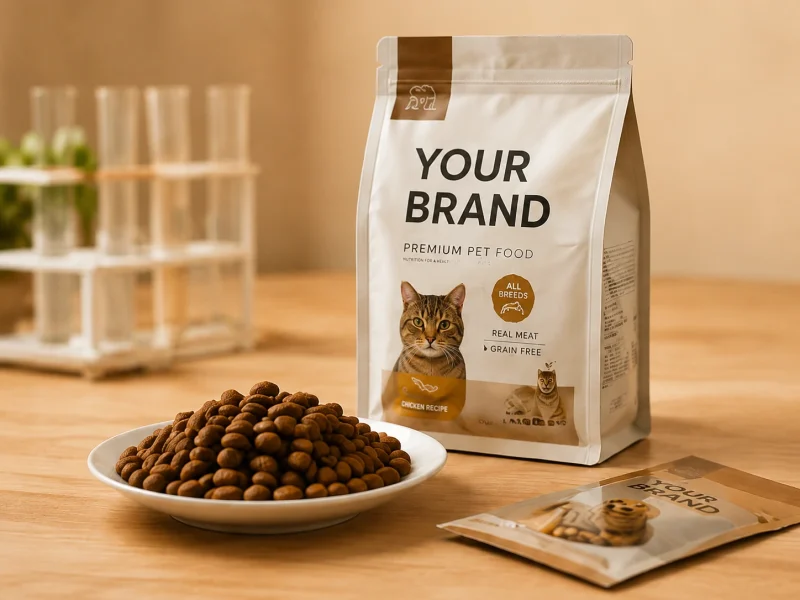
Compare pet food formats and intended uses
Use this pet food guide to compare product formats and key supplier information. For each format, check the label and supporting evidence to understand the intended feeding purpose.
| Format | What to specify | What to check |
|---|---|---|
| Dry kibble | Recipe, kibble size, bag size | Feeding purpose and storage guidance |
| Wet food | Texture, portion size, can or pouch | Feeding purpose and storage instructions after opening |
| Freeze-dried food | Recipe, piece size, pack format | Whether it is a complete food, topper, or treat |
| Treats & snacks | Intended use, piece size, portions | Label wording and feeding directions |
Start with the label. A wet, dry, or freeze-dried format alone does not establish whether a food can be used as the sole diet.
Nutrition: match species and life stage

First, check the intended species, life stage, and nutritional adequacy statement. A single protein value or a familiar ingredient is not enough to determine whether a food is suitable for a pet.
For products sold in the U.S., the FDA’s guide to complete and balanced pet food explains the role of AAFCO nutrient profiles and feeding trials.
Check the nutritional claim. Ask which life stage the recipe is intended for and what evidence supports its nutritional adequacy statement. For pets with medical needs, discuss feeding choices with a veterinarian.
Ingredients and pet food labels
Next, review the label as a whole. AAFCO’s pet food label guide explains the key information on U.S. pet food labels. Check the requirements for the market where your product will be sold.
| Label detail | Question to ask |
|---|---|
| Species, life stage & feeding purpose | Which species and life stage is the product intended for, and is it complete or supplemental? |
| Nutritional information | Are the nutrient analysis and calorie information clearly stated? |
| Ingredient list | Does the ingredient list match the agreed product specification? |
| Directions & pack details | Are the feeding instructions, storage guidance, net weight, and supplier details clear? |
Finally, compare the proposed artwork with the approved specification. Resolve differences before printing, especially when a product will be sold in more than one market.
Pet food quality: ask for evidence
This pet food guide outlines the quality checks to discuss with your supplier. Ask how ingredients are approved, batches are identified, and quality concerns are investigated.
- Agree on the product specification and test plan.
- Ask how the supplier links each batch to its records.
- Review the scope and validity of relevant certificates.

| Evidence | What to review | Why it helps |
|---|---|---|
| Product specification | Agreed recipe, ingredients, and acceptance limits | Defines what is being supplied |
| Test report | Product, batch, test date, and agreed tests | Links test results to the relevant product and batch |
| Batch records | Batch code and traceability information | Supports the investigation of quality concerns |
| Shelf-life & packaging information | Storage conditions and supporting information | Aligns packaging information with storage instructions |
Check the certificate holder, scope, and validity. Confirm that the certificate covers the facility, process, or product in question before referring to it in marketing materials.
OEM or ODM: define the scope and responsibilities
OEM and ODM arrangements can include manufacturing, formula development, packaging, and branding. The scope varies by supplier, so agree on the specific deliverables before starting the project.
Use this pet food guide to turn your idea into a written project brief. Confirm who owns the formula, who approves samples and artwork, and who reviews market-specific labels.
| Decision | OEM questions | ODM questions |
|---|---|---|
| Formula | Can you manufacture to our agreed specification? | What formula development services or existing recipes are available? |
| Samples | How will a production sample be approved? | How are development samples and revisions handled? |
| Ownership | Who owns the recipe and production specification? | What rights to the formula and exclusivity terms can we agree on? |
| Packaging | What artwork files and packaging details do we need to provide? | What design and packaging support is included? |
For either arrangement, request a product-specific quotation. Confirm the minimum order quantity, packaging requirements, sample fees, production timeline, and delivery terms before finalizing your launch schedule.
Turn the guide into a practical project brief
- Define the brief: specify the target market, species, life stage, product format, pack size, and expected order volume.
- Review the sample: agree on the recipe, packaging, test plan, and any revisions before production.
- Approve the launch: confirm the artwork, responsibilities, quotation, and timeline in writing.
Discuss your project with BSG Pet Food
Use this pet food guide to define the feeding purpose, review quality evidence, and prepare a clear project brief. Explore the pet food range and OEM/ODM services, then share your requirements with the BSG Pet Food team.
Nutrition and labeling sources
FDA: complete and balanced pet food
AAFCO: reading pet food labels
These sources explain U.S. pet food nutrition and labeling concepts. Check the requirements for your target market.
Pet food guide FAQ
Can wet, dry, or freeze-dried food be used as the sole diet?
Check the label for the intended species, life stage, feeding purpose, and nutritional adequacy statement. A product’s format alone does not show whether it is complete and balanced. Follow the feeding directions on the label.
What should I prepare before contacting an OEM/ODM supplier?
Prepare a brief covering your target market, species, life stage, product format, pack size, expected order volume, and planned launch date. Also explain whether you already have a formula or need development support.
What is the minimum order quantity for custom pet food?
The minimum order quantity (MOQ) depends on the recipe, product format, packaging, and production arrangements. Request a quotation for your product and ask whether samples or trial production are available.