
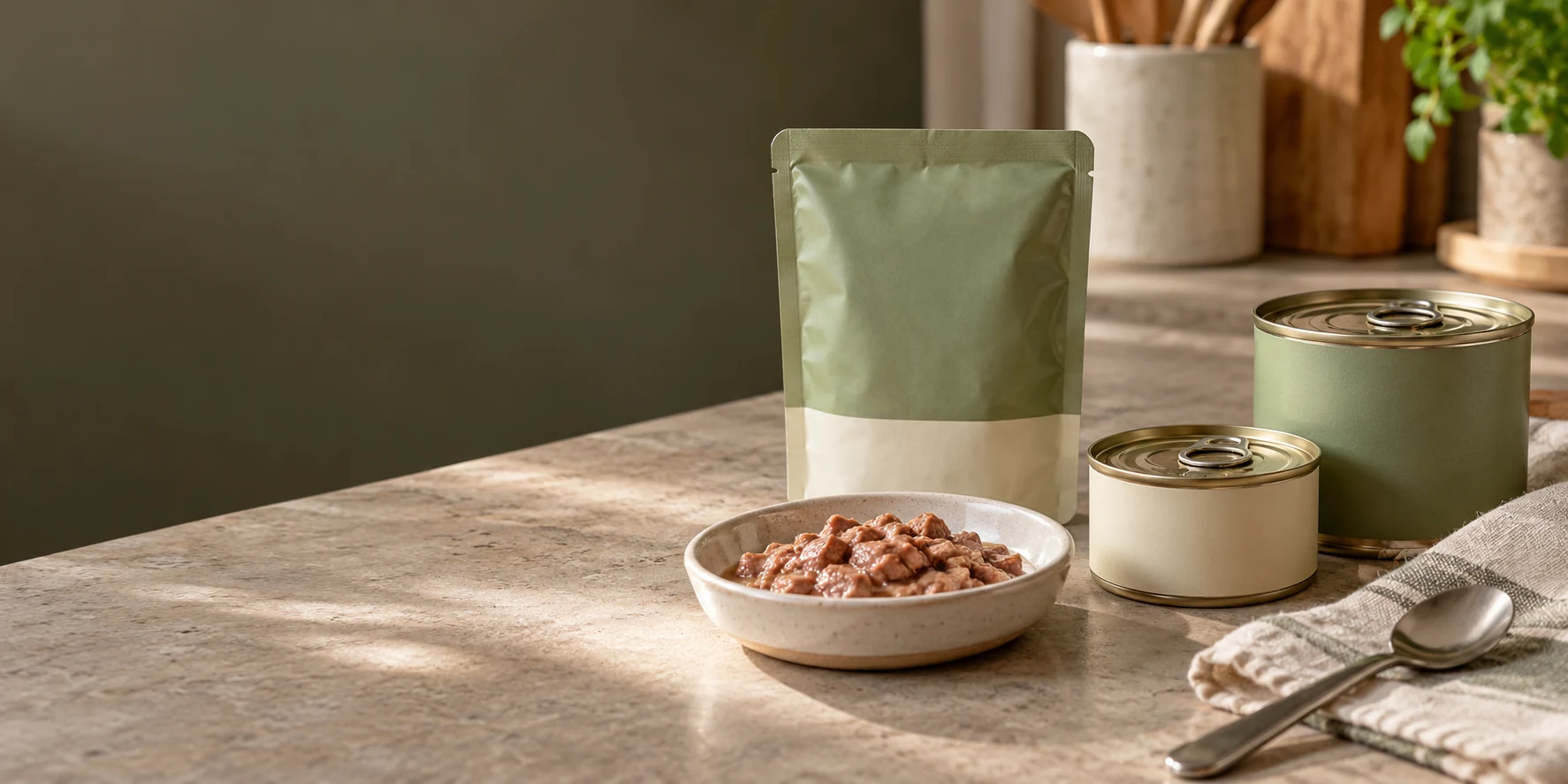
When comparing cat food pouches vs cans, start with a suitable recipe. Then choose the texture, pack size and handling features that fit your cat’s meals.
Pouches are flexible packs; cans are rigid metal containers. Both may hold complete or complementary foods, as FEDIAF’s wet food guide explains. This guide covers shelf-stable wet food.
01 / OPEN, SERVE, COMPARE
Cat food pouches vs cans: advantages and limitations
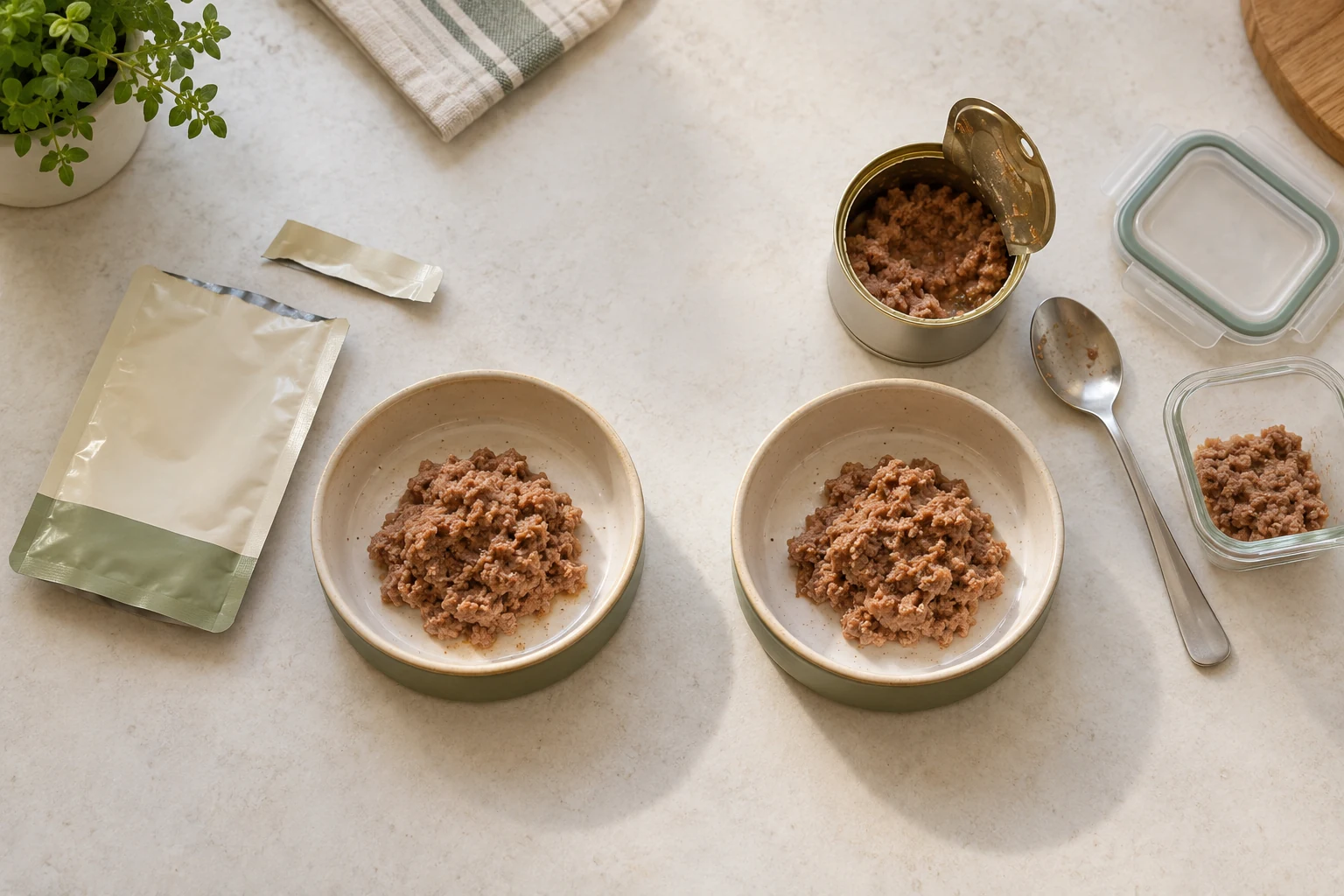
Judge the actual pack: opening width, rigidity and pouring or spooning access affect serving. Net weight and calories determine how many planned portions it supplies.
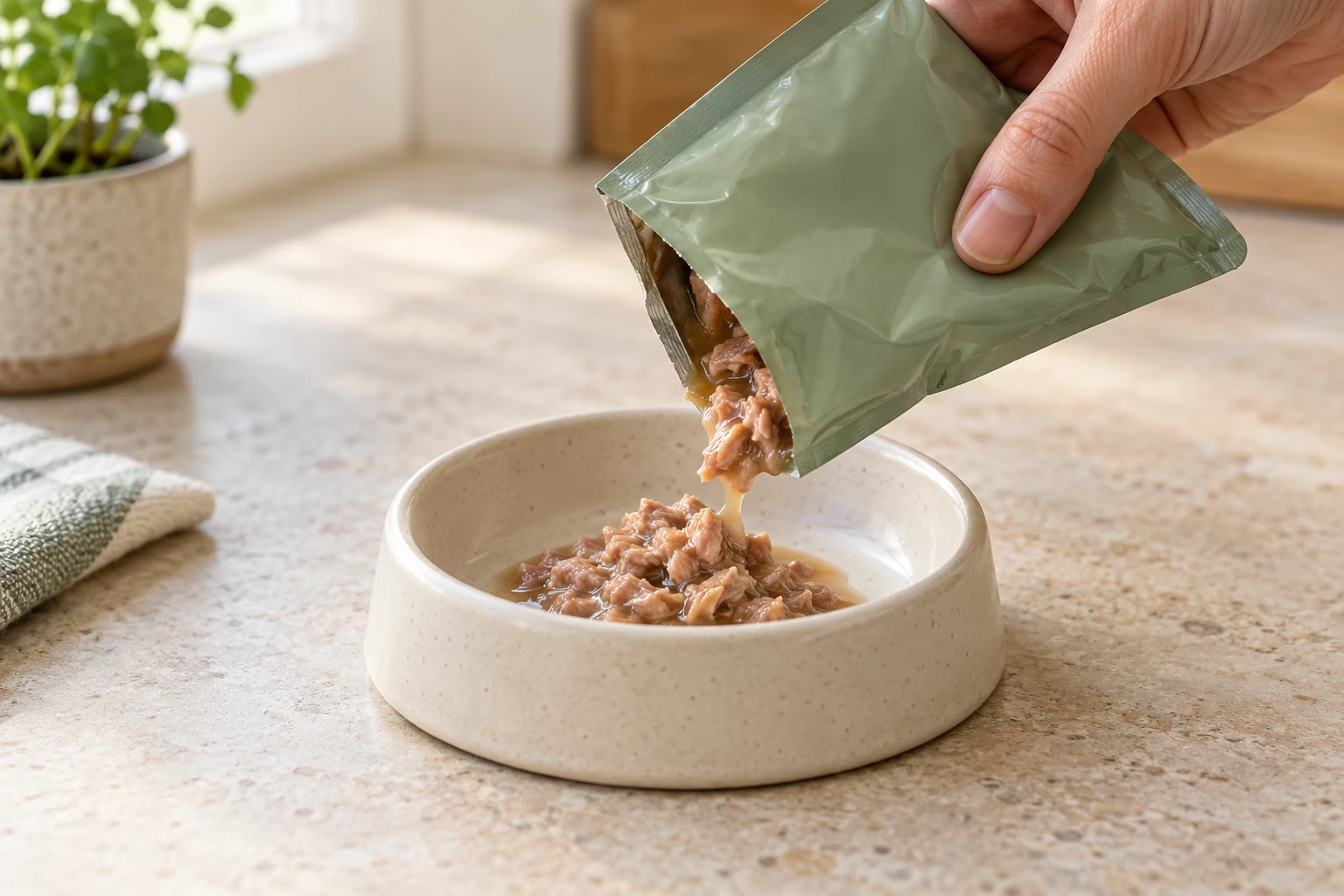
FLEXIBLE PACK
Pouches: light and flexible
- Light and compact: the empty pack takes little storage space.
- Serving: squeezing or pouring can be quick, especially for food in sauce. Test whether pieces clear the opening.
- Pack size: a sachet close to your planned serving may reduce leftovers. Small cans can offer the same benefit.
What can be awkward?
Food can cling to corners and film. Check whether you can empty the pack neatly and cover any remainder securely. A narrow opening can make scraping difficult; use a covered container if the pouch cannot be closed properly.
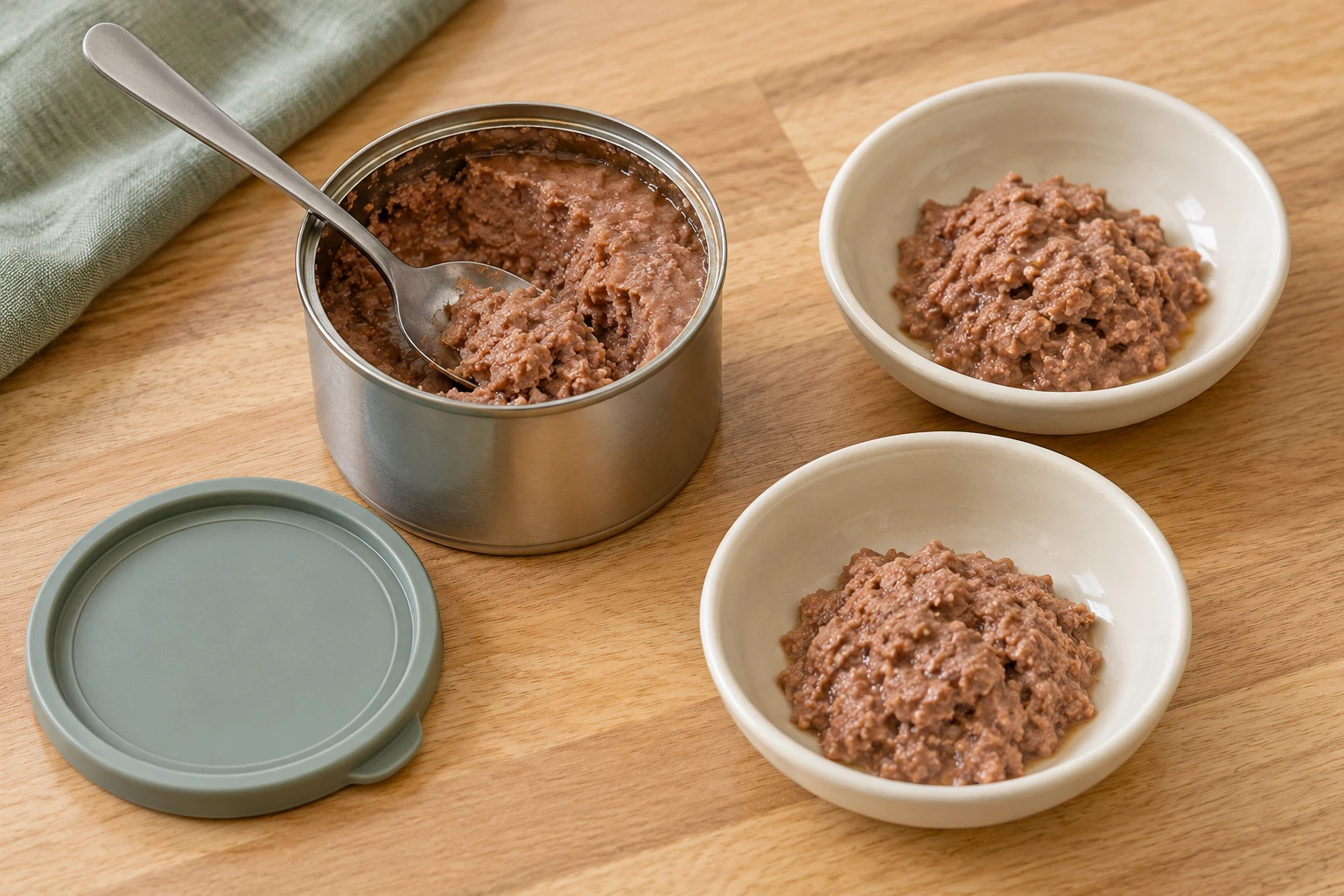
RIGID CONTAINER
Cans: stable and easy to spoon from
- Support: the rigid body keeps its shape while you spoon out food.
- Access: a wide opening lets you see the contents, spoon out a loaf or divide food between bowls.
- Size choice: compare grams and calories per pack; larger cans can suit combined portions in a multi-cat home.
What can be awkward?
A larger can leaves more to manage when you serve small portions. Check the opener, fitted lid and cupboard space; serve food in a bowl. The rigid container also adds weight, which may matter when carrying several meals.
Try one pack first. Open it, serve a measured portion and check how much food remains inside. A pouch suits quick pouring if it empties easily; a can suits spooning and dividing if the opening and lid work for you.
02 / READ THE LABEL
Reading cat food labels: pouches vs cans
For main meals, start with nutritional adequacy. In the US, the FDA explains “complete and balanced” claims. In other markets, check the applicable wording on the label.
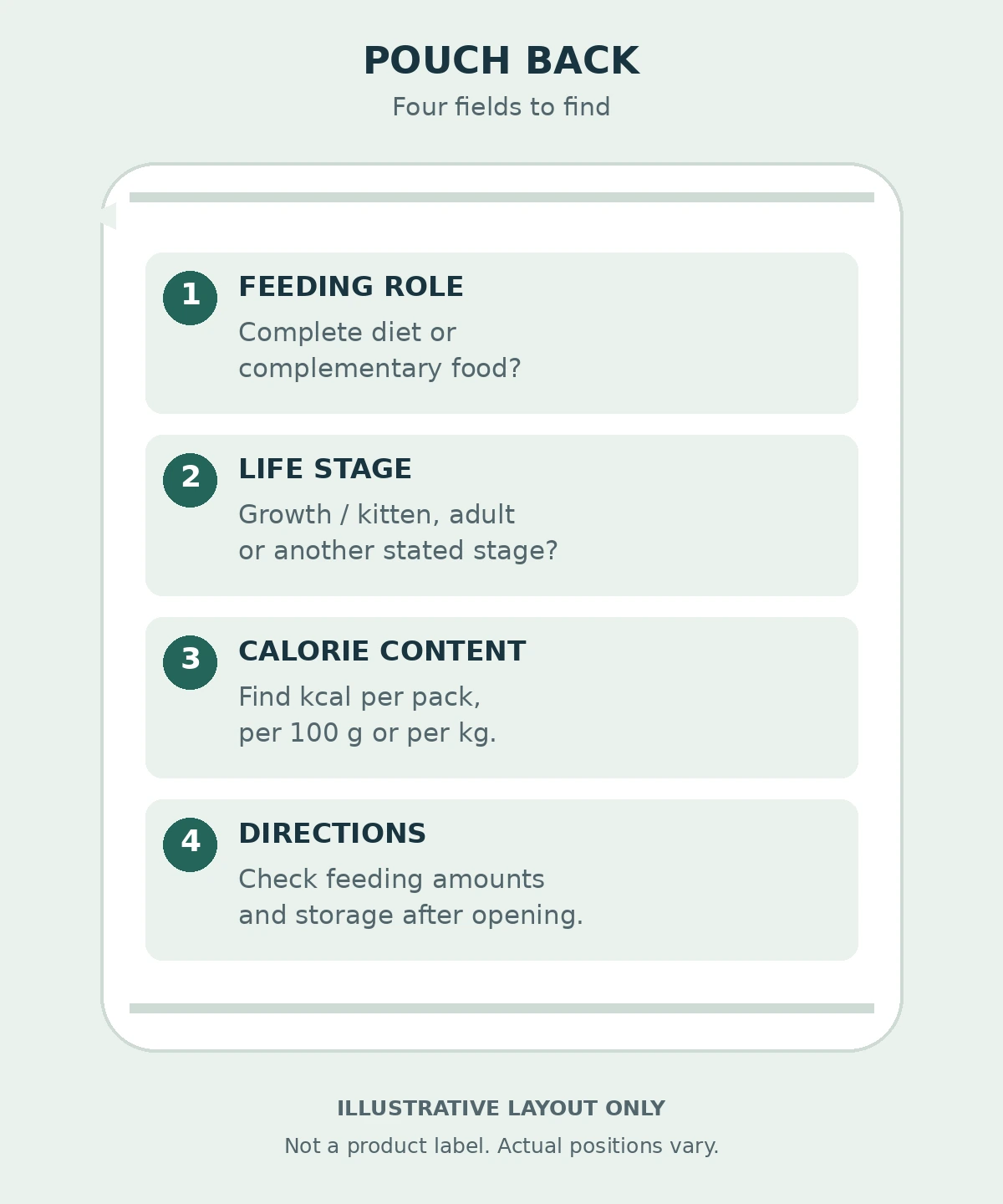
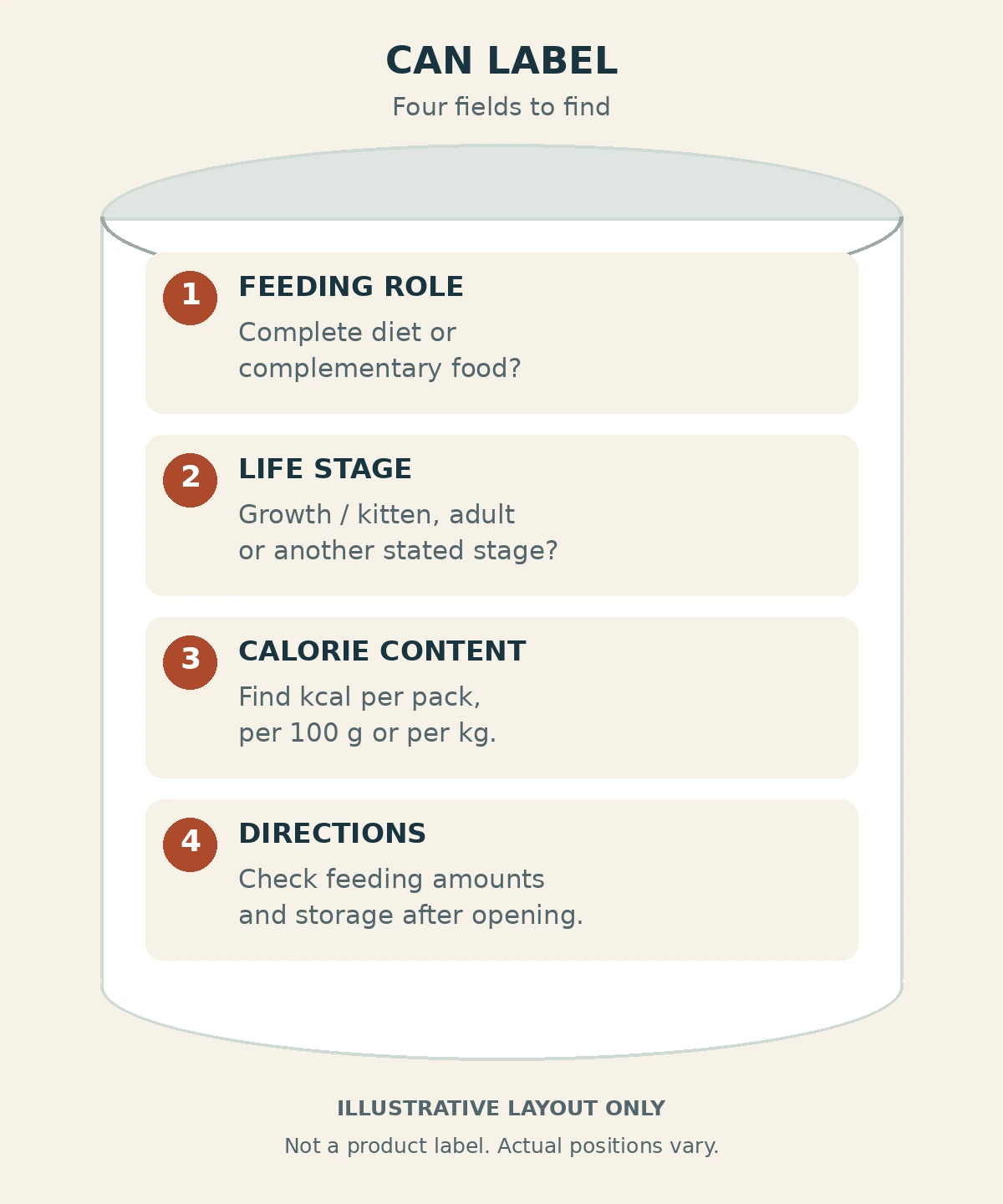
Swipe to compare the two label layouts →
Check four label details
- Feeding role: look for a complete diet if the food supplies the main meals. Complementary foods, treats and toppers need a different place in the plan. An appealing product name or picture does not establish suitability as a sole diet.
- Life stage: match the stated suitability to your cat, such as growth for kittens or adult maintenance. A complete adult-maintenance food is not automatically suitable as a kitten’s main diet. Confirm suitability for any special dietary needs.
- Calories: find kcal per pack, or calculate it from the labeled energy and weight. Check whether the figure is per pack, per 100 g or per kilogram. WSAVA recommends checking energy information. Ask the manufacturer for missing data.
- Directions: read the feeding and storage instructions before choosing a size. Check whether the suggested amount assumes wet food alone or mixed feeding. Use the guide with your established plan and monitor intake.
Multi-cat check. Confirm suitability for every cat before sharing one pack.
03 / WHAT IS IN THE BOWL?
Comparing cat food textures: pouches vs cans
Choose the food your cat will eat, then compare the container. Both formats can offer smooth foods, shreds or chunks.
Jelly and gravy describe the surrounding medium. Shreds or chunks may come in either.
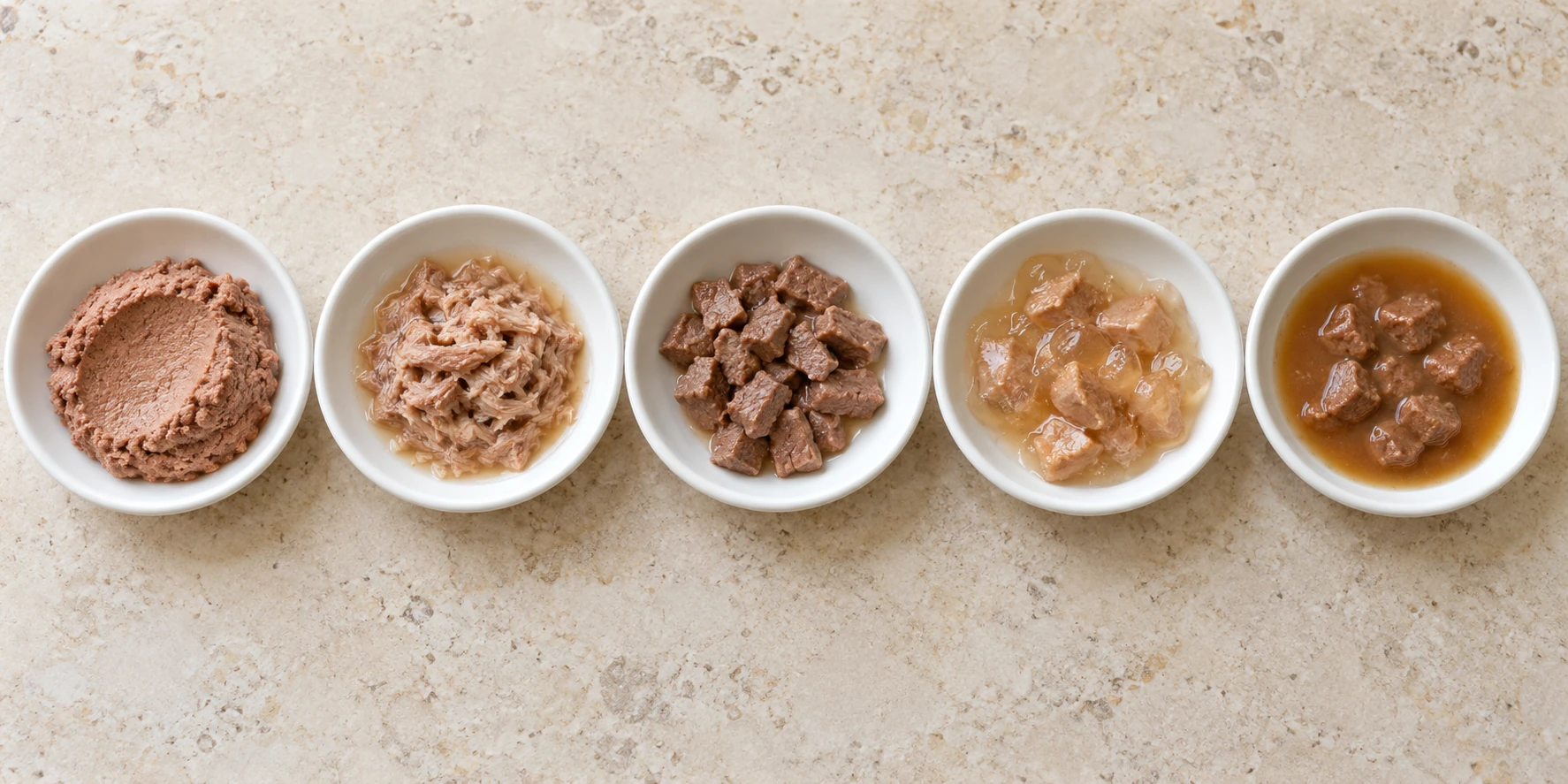
Food form
Pâté or mousse
A relatively uniform, smooth or finely ground food. Check how easily it breaks apart with a spoon.
Shreds
Visible strands of meat or a shredded-style mixture. Compare strand length as well as the amount of surrounding sauce.
Chunks
Distinct pieces, which may be formed or cut. Look at piece size and firmness when comparing recipes.
Surrounding medium
Jelly
A gelled surrounding medium, often with pieces. Check the pieces inside as well as the gel around them.
Gravy
A more fluid sauce surrounding pieces or shreds. Note how much of the serving consists of solids.
04 / MATCH THE PACK TO THE MEAL
Meal portions for cat food: pouches vs cans
A pack is not automatically one meal. Match its calories to your planned wet-food share. Equal weights of different foods may provide different amounts of energy.
- Set the wet-food share: use the wet-food allowance in your feeding plan. Account for dry food, treats and toppers rather than adding wet food on top.
- Split between meals: divide the daily wet-food calories among the meals you serve. Unequal portions are fine if they fit the plan.
- Convert calories to grams: use the chosen recipe’s kcal/g to calculate each serving, then measure it before putting the pack away.
- Match the pack: compare the measured portion with the pack size. Work out what remains after each meal and whether you can use it within the labeled storage period.
kcal/g = kcal per pack ÷ pack weight in grams
Grams per meal = planned wet-food meal kcal ÷ kcal/g
For kcal per 100 g, divide by 100 to get kcal/g. For kcal per kg, divide by 1,000.
For small meals, compare small packs in either format. For shared feeding, total each cat’s separately measured portion before choosing a larger pack. Serve the portions in separate bowls so you can see what each cat actually eats.
05 / PLAN FOR THE REMAINDER
Storing opened cat food: pouches vs cans
An opened pouch and an opened can both need proper handling. A pack finished in one day can still need refrigeration between meals. Choose a closure or covered container you can use reliably at the next feeding.
If the pack is finished in one serving
Serve the measured food into a clean bowl. Follow the product’s directions for food left in the bowl; an empty package does not mean the serving was eaten.
If food will remain in the pack
- Cover and chill: promptly refrigerate unused food, tightly covered, or discard it. The FDA recommends keeping the refrigerator at 40°F (about 4°C) or below.
- Mark opening time: record the date and time so you can follow the product’s limit after opening.
- Retain product details: keep the product name and batch code, including when you transfer food to another container.
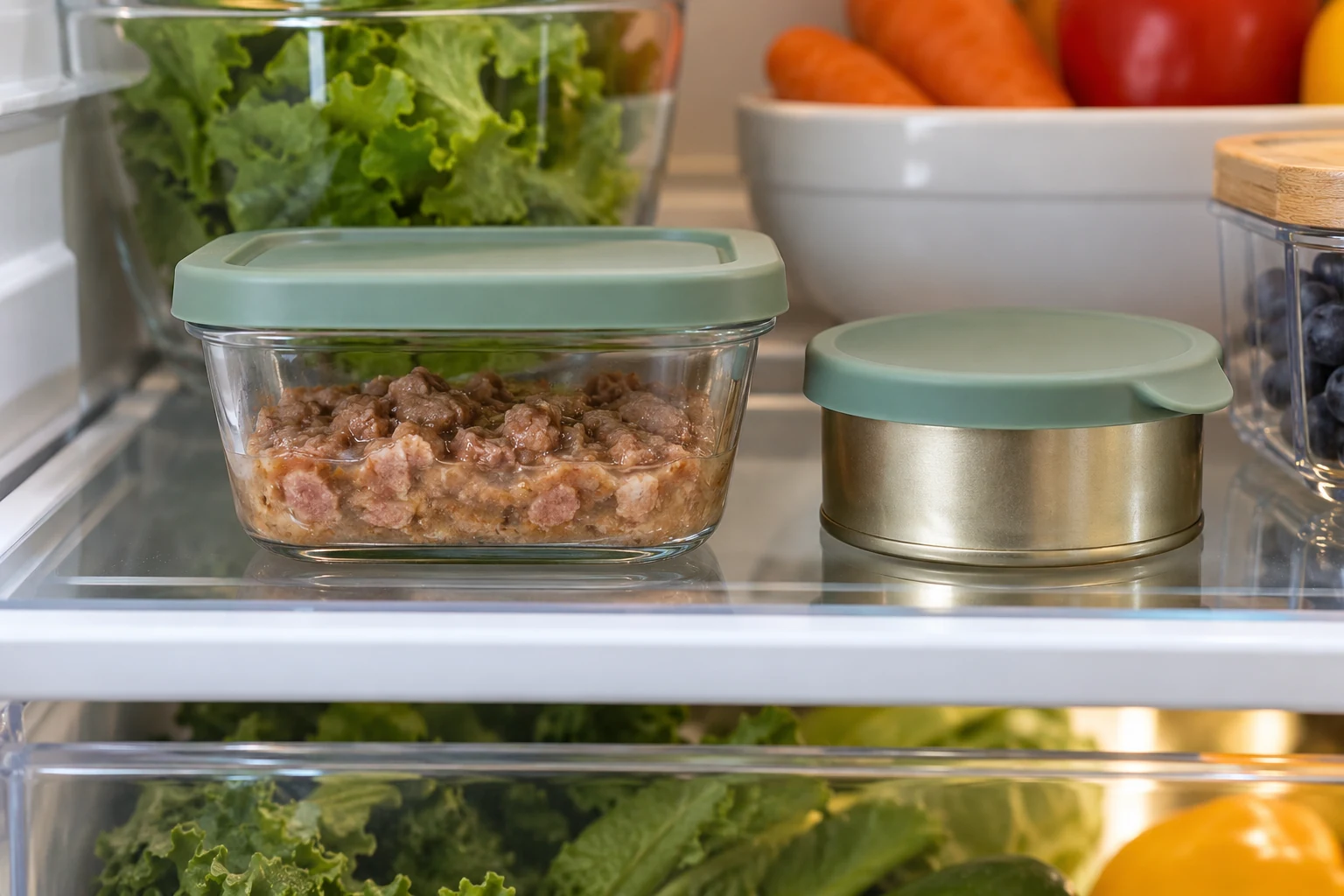
Cover pouches and cans securely, or use a covered container. Transferring food does not restart the storage period. Follow the FDA’s storage guidance. Wash bowls and utensils.
Buy unopened packs in good condition and store them as labeled. Check the seal and date before use.
06 / THE PRICE YOU REALLY PAY
The real cost of cat food: pouches vs cans
Compare prices only after the foods pass the nutrition and texture checks. Look at price per 100 g and cost per 100 kcal, then include food discarded. A cheaper larger pack can cost more per usable meal when leftovers are repeatedly discarded.
Hypothetical comparison
Assume both are complete adult diets, with 100 kcal/day of wet food in the plan. Products, prices and intake are illustrative, not feeding recommendations.
| Pack data and comparison | Pouch A | Can B |
|---|---|---|
| Net weight | 100 g | 200 g |
| Energy per pack | 100 kcal | 250 kcal |
| Price per pack | $1.50 | $2.40 |
| Price per 100 g | $1.50 | $1.20 |
| Cost per 100 kcal | $1.50 | $0.96 |
The daily amount is 100 g of Pouch A or 80 g of Can B, divided into meals according to your plan.
Refrigerate pouch remainders between meals as labeled. The can leaves 120 g after the first day.
$1.50/day
Pouch A: all food used
One pouch supplies the day’s 100 kcal.
$0.96/day
Can B: all contents used
Average daily cost if the whole can is used within the labeled storage period. The can costs $2.40 upfront.
$2.40/day
Can B: 120 g discarded
If only 80 g is used from each can and 120 g is discarded, the day’s food costs the full $2.40.
Track what is served and discarded across the whole pack. Keep portions fixed when comparing sizes. Repeated package remainders suggest trying a smaller pack; food left in the bowl calls for a review of portions or texture.
Quick answers
Are pouches healthier than cans?
No format is inherently healthier. Compare nutritional adequacy, life stage and calories.
Are pouches fresher or less processed?
A pouch alone proves neither freshness nor processing level. Check the product description.
Can I switch between formats?
Yes, if both foods suit your cat and serve the same role. Recalculate portions and introduce changes gradually.
What if my cat only licks the gravy?
Check uneaten solids. Introduce a suitable alternative gradually; seek veterinary advice for persistent poor appetite.
Can leftovers stay in the can?
Follow the label; refrigerate promptly under a fitted lid or in a covered container.
How long does opened food keep?
Follow the product’s instructions; the unopened best-before date does not set the storage period after opening.
Compare product labels
Compare cat food pouch formats and canned cat food options using current labels and calorie information.
Sources and further reading
- FDA: “Complete and Balanced” Pet Food
- FDA: Tips for Safe Handling of Pet Food and Treats
- FDA: Proper Storage of Pet Food & Treats
- WSAVA: Guidelines on Selecting Pet Foods
- FEDIAF: How wet pet food is made
- Cornell Feline Health Center: Choosing and Caring for Your New Cat
Illustrative images and labels. Hypothetical products, prices and intake.