
THE MEALTIME EDIT
How to Use Freeze-Dried Cat Treats as Toppers
Using freeze-dried cat treats as toppers adds a different aroma or texture to a familiar meal. This guide shows you how to weigh a portion, check the preparation instructions, and mix it into dry or wet cat food.
AT A GLANCE
Prepare and weigh → check whether water is needed → choose dry or wet food → observe the whole meal.
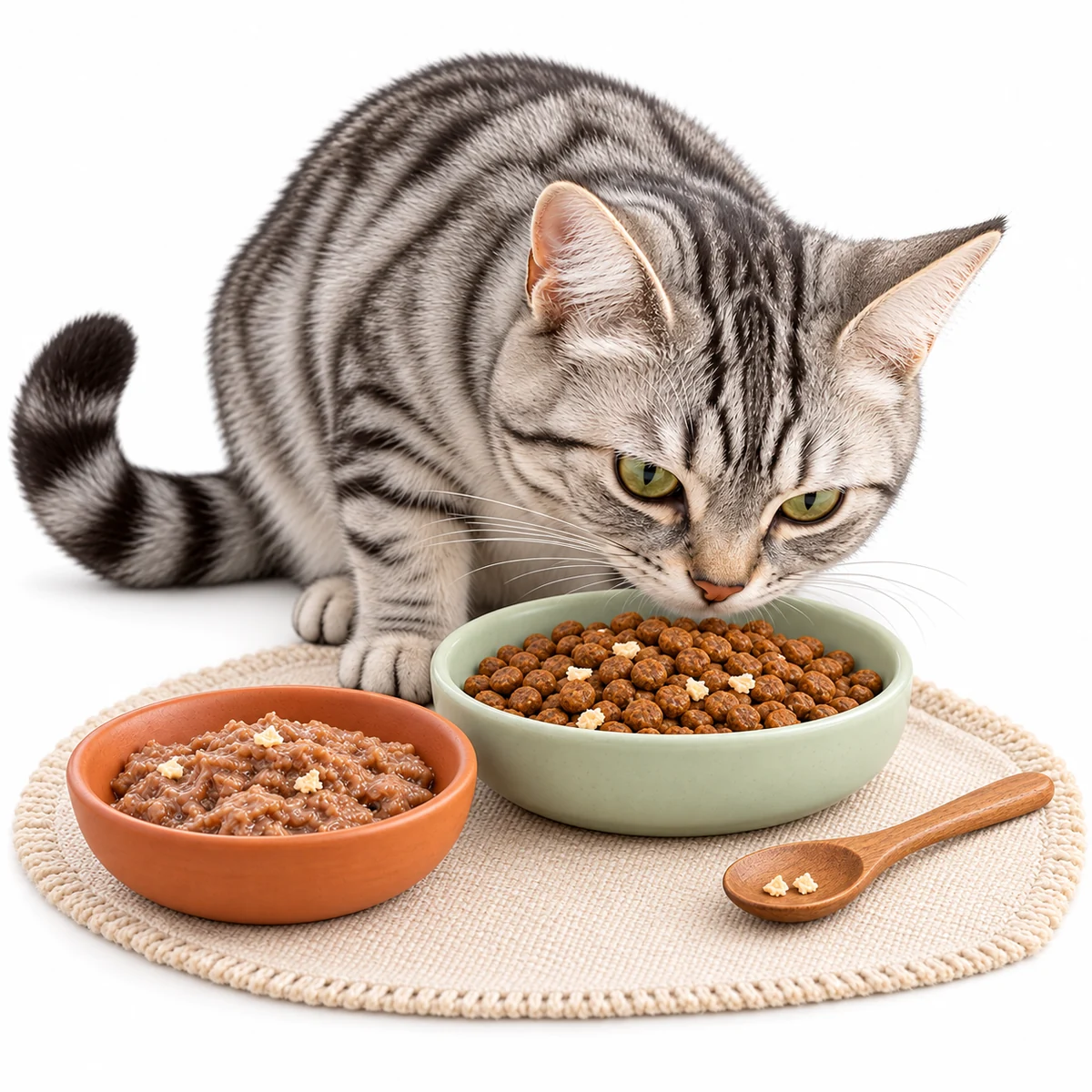
These photos illustrate the method. Base the actual portion on the product’s calorie content and your cat’s feeding plan.
WHAT IT IS
What is a food topper?
A food topper is an addition sprinkled over or mixed into a cat’s usual food. Freeze-dried treats can be crumbled for this purpose.
WHY TRY IT
Why add a topper?
A topper changes a meal’s aroma, texture, or crunch. Adding one is optional; it does not guarantee an improved appetite or better nutrition.
For more on food preferences, read ourguide to choosing cat food flavors.
01 / CHOOSE
How to choose a suitable product
Check these five points before buying a product to use as a topping.
CHECK 01
Age and dietary needs
Check that the product is intended for cats and suitable for your cat’s age. If your cat is on a prescribed or elimination diet, ask your veterinarian before adding a new ingredient.
CHECK 02
Treat or complete food
Check whether the product is a treat or a complete food. The nutritional adequacy statement on the label explains whether a food provides complete and balanced nutrition. TheFDA explains what “complete and balanced” means.
CHECK 03
Ingredients and calories
Read the full ingredient list and check how many calories the product provides per gram (kcal/g) or per piece. If calorie information is missing, ask the manufacturer. Piece sizes and densities can vary.
CHECK 04
Dry or softened
Check whether the product can be served dry or must be rehydrated (softened with water) before feeding.
CHECK 05
Processing and storage
Confirm that the product is cooked, then check how to store it after opening and how soon to use it after adding water or mixing it with wet food.
Freeze-dried does not mean cooked.Freeze-drying raw ingredients does not kill all germs, and adding water does not cook them. TheCDC advises against raw pet food and treats. Choose a cooked product. If the processing method is unclear, ask the manufacturer.
02 / PLAN
How much should you add?
Treats cannot replace complete and balanced cat food. Work out your cat’s daily treat allowance before choosing a topper portion.WSAVA recommends keeping treats below 10% of daily calories. Count all snacks and toppings toward that allowance. Your veterinarian may recommend a lower limit.
The amount you actually use may be much smaller than the calculated upper limit. Plan the main food and all extras within the daily calorie total. Ask your veterinarian about any changes needed to the main-food portion.
One worked example: the daily upper limit
Example assumptions:a healthy adult cat follows a feeding plan that allows 200 kcal per day. Other treats provide 8 kcal, and the hypothetical topper provides 4 kcal/g. These figures are for illustration, not a serving recommendation or a verified BSG product specification.
| Input | Example value |
|---|---|
| A: total daily calories | 200 kcal |
| B: other treats that day | 8 kcal |
| C: topper calories per gram | 4 kcal/g |
If a label lists calories per kilogram, convert them first:
kcal/g = kcal/kg ÷ 1000
In this example, 4,000 kcal/kg ÷ 1000 = 4 kcal/g.
Calculated daily upper limit (g) = ((A × 0.10) − B) ÷ C.
Here, 10% of 200 kcal is 20 kcal. Subtracting 8 kcal leaves 12 kcal. At 4 kcal/g, the total topper portion must remainbelow 3 g for the whole dayto keep total treats below 10%.
This upper limit is not a target serving or a per-meal amount.If other snacks already use up the treat allowance, no calories remain for a topper.
A hypothetical split between two meals
Suppose the cat in this example receives1 g of topper for the entire day, split equally between two meals. This hypothetical amount is below the calculated upper limit; it is not a serving recommendation for every cat.
| Role | Illustrative amount |
|---|---|
| Calculated daily upper limit | Below 3 g |
| Chosen actual daily amount | 1 g |
| Number of meals | 2 |
| Portion for each meal | 0.5 g |
At 4 kcal/g, the chosen 1 g portion provides 4 kcal for the day, or 2 kcal per meal when split equally. Include the main food and all other treats in the same daily calorie total.
For the methods below, usethe portion determined for the product and your cat’s feeding plan.
03 / PREPARE AND MIX
How to mix freeze-dried cat treats as toppers
Use the portion set in your cat’sfeeding plan. Prepare the topper as directed on the label, then follow the method for dry or wet food that matches this meal.
1. Prepare and weigh

The 0.50 g display illustrates the hypothetical per-meal amount above; it is not a serving recommendation. These photos illustrate the method. Base the actual portion on the product’s calorie content and your cat’s feeding plan.
Use the familiar main food your cat already eats. Set out the portions of main food and topper for this meal, along with a clean bowl, spoon, and suitable scale. Wash your hands before handling the food.
Place a clean, dry dish on the scale and reset it to zero.Weigh the freeze-dried treats on their own, before crumbling them or adding water.Use a scale precise enough to register the planned portion; a less precise scale may still show zero after food is added.
Keep the measured pieces in the dish while you check the preparation instructions. Keep the packet away from water and wet food.
2. Check whether water is needed
Choose the preparation option allowed by the product label. Adding water is not a compulsory step for every freeze-dried treat.
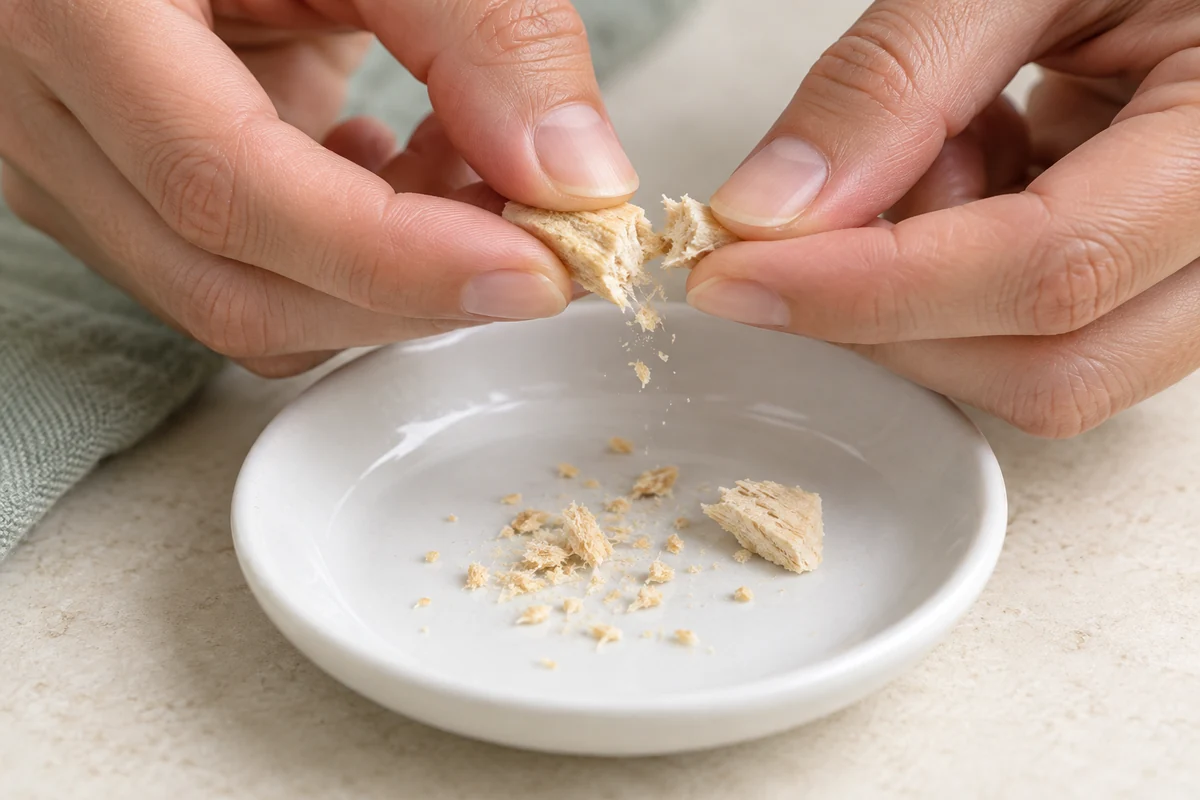
DRY OPTION
If the label allows dry feeding
Transfer the weighed pieces to a clean, dry dish. Break them into small flakes and crumbs, or press them gently with the back of a spoon. Break up any large pieces so they can be distributed through the food.
Keep all the measured crumbs together for mixing. The photo shows an intact piece beside fine crumbs. Use the scale to determine the portion. If the product permits dry feeding, water is optional unless your veterinarian advises otherwise.
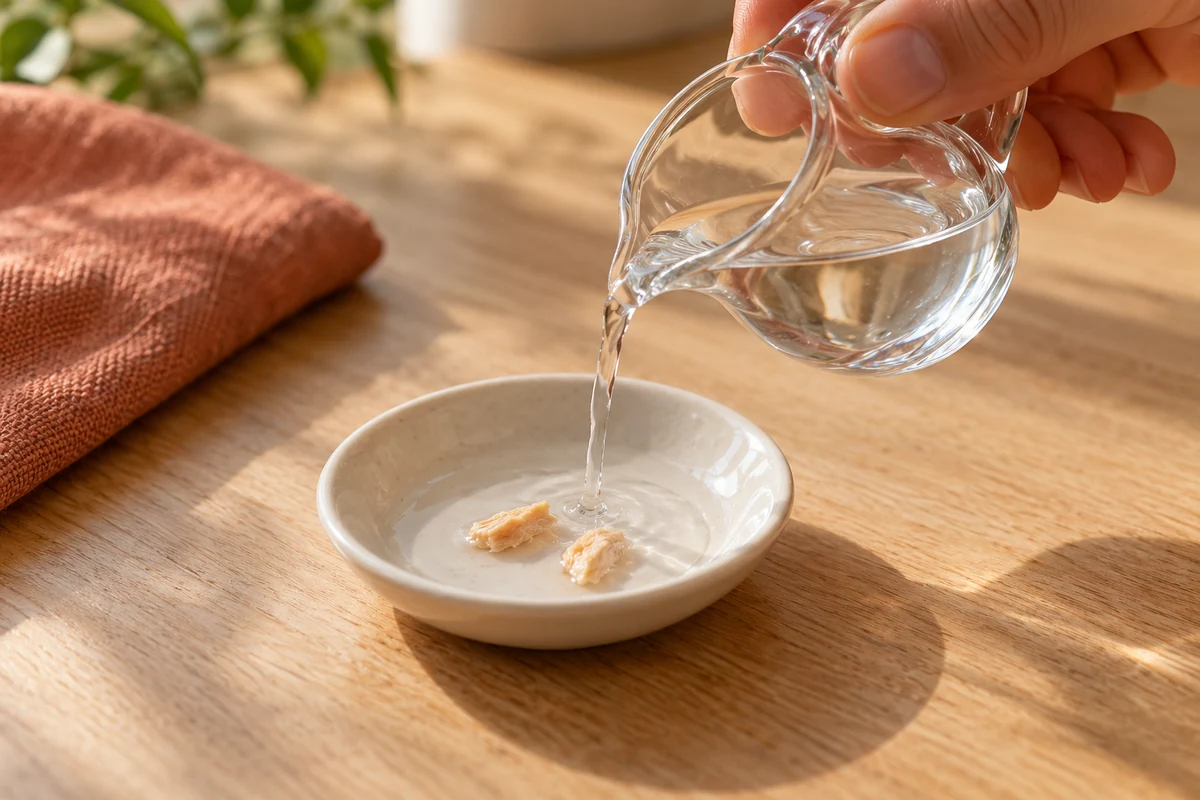
WATER OPTION
If water is required
Rehydrate the measured portion in a separate clean dishbeforeadding it to the main food. Follow the label for all three details:water amount, water temperature, and waiting time. Prepare the pieces in the form specified by the manufacturer.
Wait as directed, then use the softened portion in the mixing method below. Water amounts and waiting times vary by product. If instructions are missing, ask the manufacturer before preparing it. See thestorage sectionfor handling food once it is moistened.
These photos illustrate the method. Base the actual portion on the product’s calorie content and your cat’s feeding plan.
3. Choose one mixing method
Choose dry food or wet foodbelow. Use the dry crumbs or rehydrated portion prepared above, as the label allows.
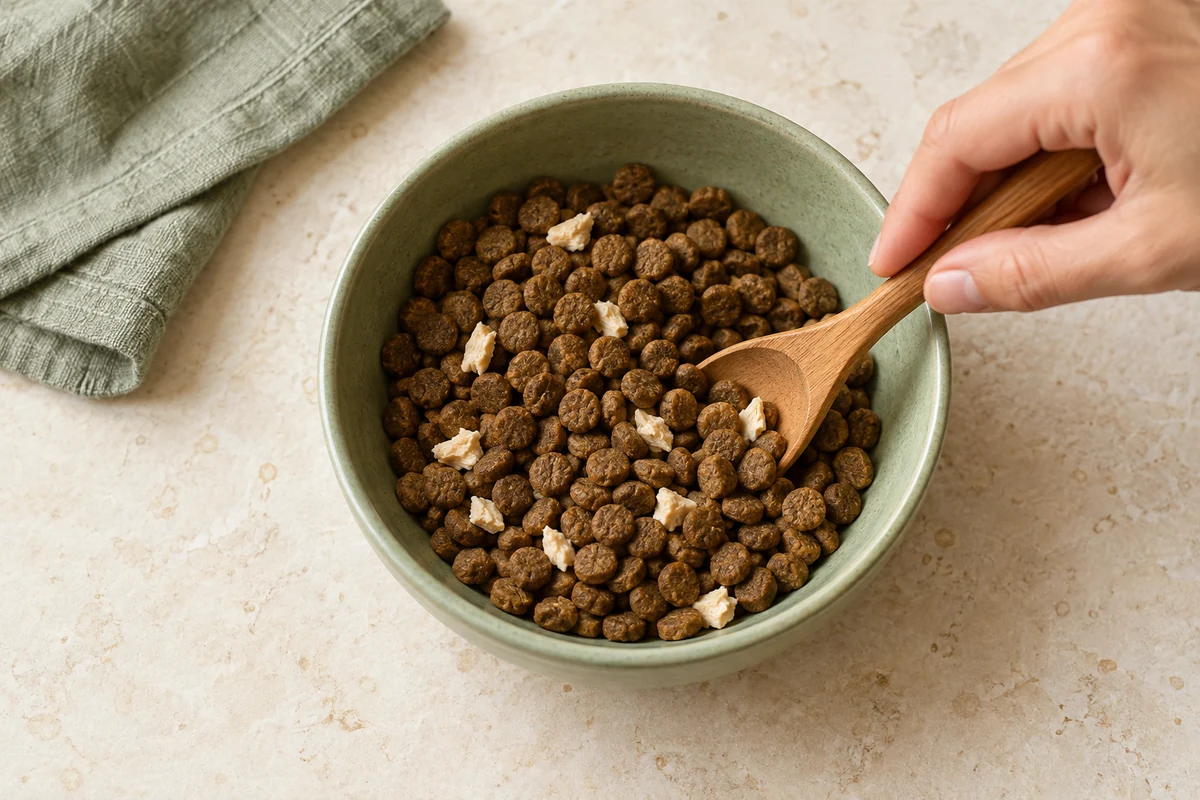
DRY FOOD
Sprinkle or mix through kibble
For a surface sprinkle:when the label allows dry feeding, scatter the crumbs lightly across the kibble. This leaves them on top and makes them easier for your cat to pick out.
To mix through the meal:put part of the planned kibble portion in the bowl. Distribute some of the prepared topper over it and stir gently. Add the remaining kibble and topper, then lift and turn the food with the spoon.
Check several areas of the bowl: the crumbs should be dispersed among the kibble, without a thick surface layer or a pile at the bottom. If your cat picks out the treats, use finer crumbs and distribute them more evenly next time.
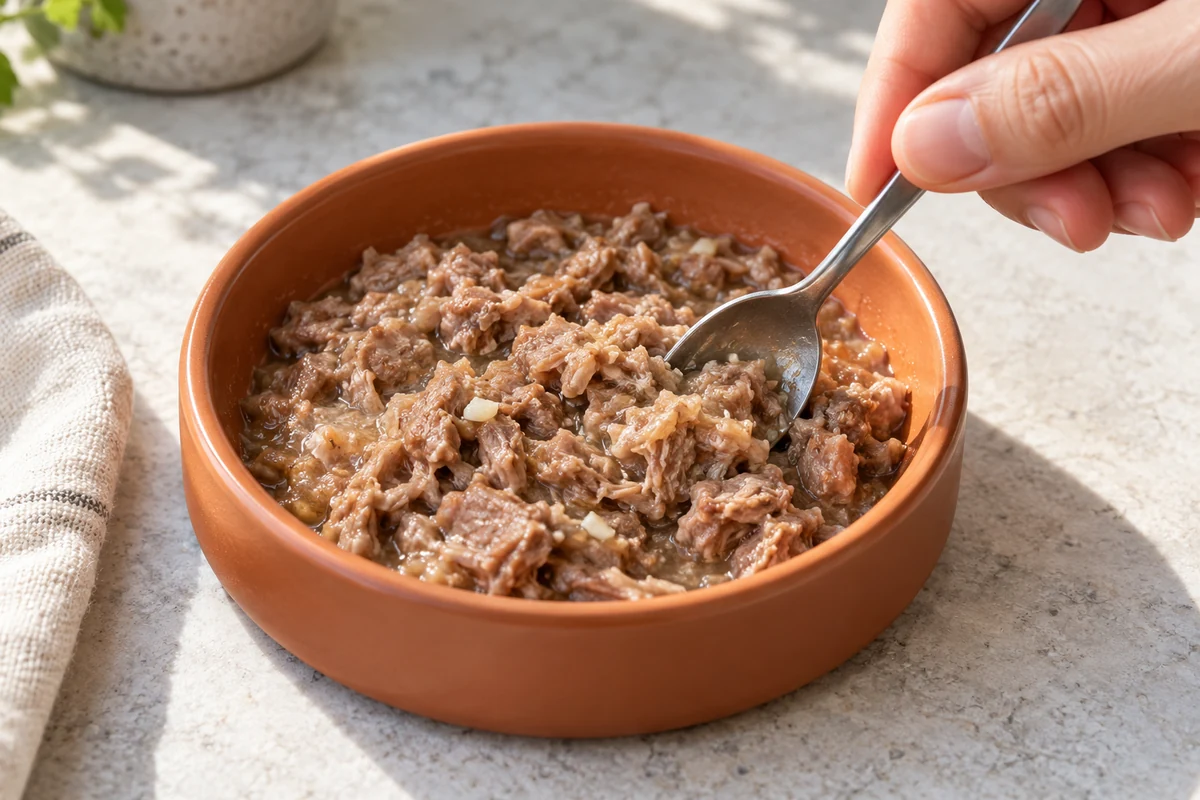
WET FOOD
Sprinkle or fold into wet food
For a surface sprinkle:when the label allows dry feeding, spread the wet food in the bowl and scatter the crumbs across it. This keeps most of the original texture, but leaves the topping easier to lick off.
To mix through the meal:take a small spoonful from the wet-food portion already set aside. Blend the prepared topper into that spoonful, then return it to the bowl. Lift food from the edges toward the center and fold it over until the topper is distributed throughout.
Move the spoon gently between any chunks in gravy. Check for dry clumps or pockets of unmixed crumbs. The spoonful comes from the planned meal; it is not an extra serving.
These photos illustrate the method. Base the actual portion on the product’s calorie content and your cat’s feeding plan.
4. Observe the whole meal
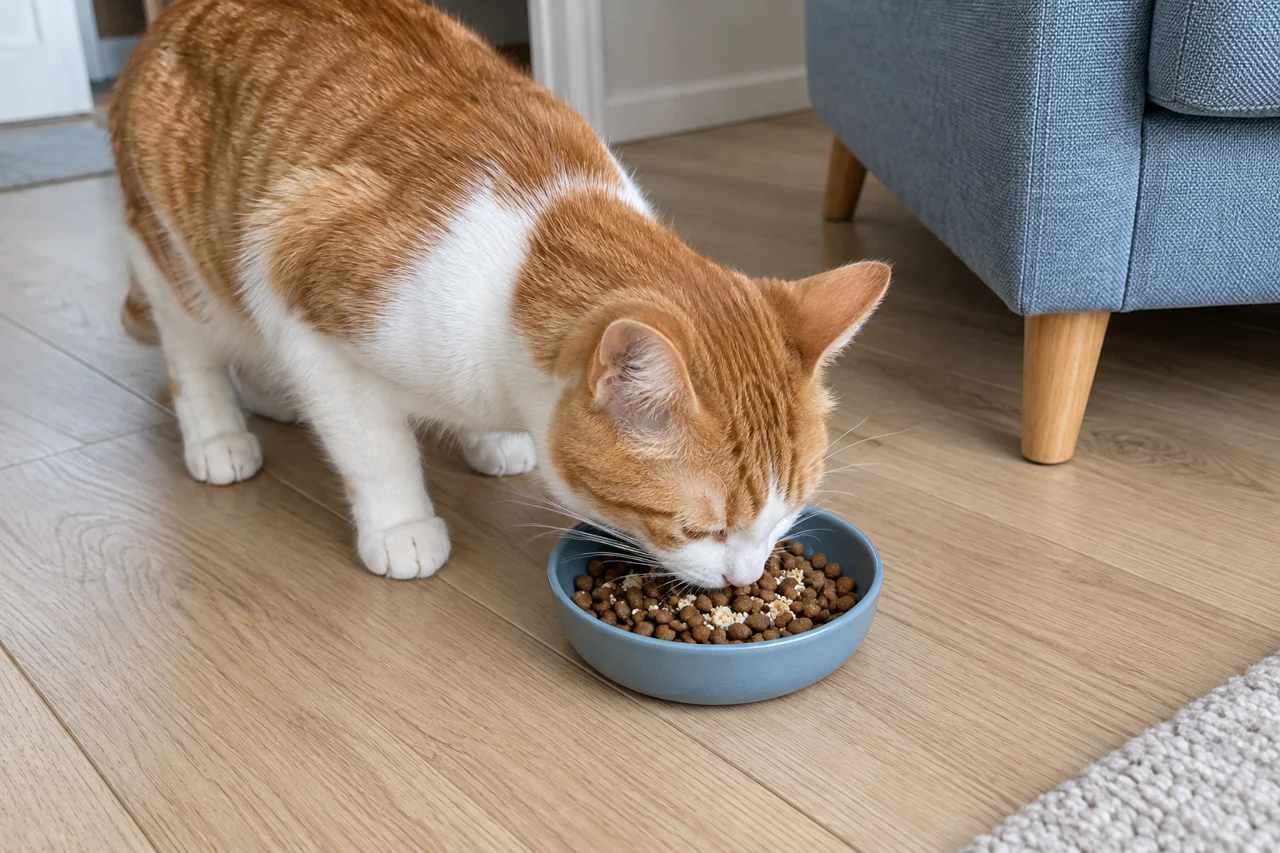
Check how much of the main food your cat eats, rather than judging the result only by whether the topper disappears. Note what was offered, whether the meal was finished, partly eaten, or mostly left, and whether your cat selected the treat pieces.
If the topping disappears while the main food remains, record that result instead of adding more topping. Use themixing tips aboveto adjust the next meal’s texture or distribution.
If your cat ignores the mixture, offer its usual food on its own and check for noise or competition around the feeding spot. Introduce only one new product at a time. Contact your veterinarian if your cat’s appetite suddenly decreases or your cat stops eating.

04 / KEEP IT FRESH
What to do after feeding
Keep dry treats separate from mixtures made with water or wet food, and from food already served to your cat. Follow the products’ storage and use-by instructions. TheFDA storage guidecovers basic food storage and refrigeration.
- Dry treats in the packet:use a clean, dry scoop and reseal the original bag after taking out a portion. Store it as directed and keep the lot number and best-by date. Do not return crumbs from a used bowl to the bag.
- Food mixed with water or wet food:make a fresh serving when practical. Only prepare food ahead when the product instructions allow it. Cover and refrigerate any unserved portions promptly as directed. If the products specify different storage times, use the shorter time. If the storage times are unclear, prepare only what you will serve now.
- Leftovers in the feeding bowl:keep these separate from portions that have not been served. Discard leftovers that have exceeded the serving-time limit or become contaminated. During the first trial, discard any remaining mixture after the meal so you can start fresh at the next feeding.
Wash and dry the bowl, spoon, and measuring utensils after use. Then clean the preparation surface and wash your hands.
A FEW MORE ANSWERS
Freeze-Dried Cat Topper FAQs
No. Plain water adds no calories. Calculate the topper’s calories from the measured dry portion before adding water.
Yes, as long as the product is still within its stated use period and has been stored as directed. Count the crumbs as part of the measured portion. Discard any that are damp, moldy, or spoiled.
Prepare meals ahead only if the product instructions allow it. Seewhat to do after feedingfor storing unserved portions, refrigeration, and leftovers.
A complete and balanced product that is suitable for your cat can form part of the main diet. See theproduct checklistto distinguish complete food from treats.
Choose a product that fits your cat’s age and existing feeding plan. Ask your veterinarian before adding anything to a prescribed or elimination diet, or if you are unsure what is suitable for a growing kitten.
FOR YOUR NEXT BOWL
Check BSG's freeze-dried chicken treat
The BSG freeze-dried product pagedescribes a chicken treat for cats and dogs and lists meal toppers among its uses. Before using it as a topper, check the specific formula against the selection criteria below.
| Selection check | Available information and details to confirm |
|---|---|
| Suitable animal and life stage | The page says the product is suitable for cats and dogs. Confirm that the selected formula suits your cat’s life stage and current diet. |
| Treat or complete food | It is described as a chicken treat. Check the label to confirm whether the specific formula is a treat or complete food, and read the full ingredient list. |
| Calories | No kcal/g or kcal/kg value is listed. Request the calorie content before calculating a portion. The worked example above is not based on BSG calorie data. |
| Processing | The page describes the product as freeze-dried. It does not state whether the product is cooked or raw or describe any treatment used to reduce pathogens. |
| Feeding, water, and storage | The page lists use as a meal topper but does not provide detailed serving, rehydration, or storage instructions. Request the current label or specification sheet. |